Why BPM matters in music for Brazilian Zouk dance
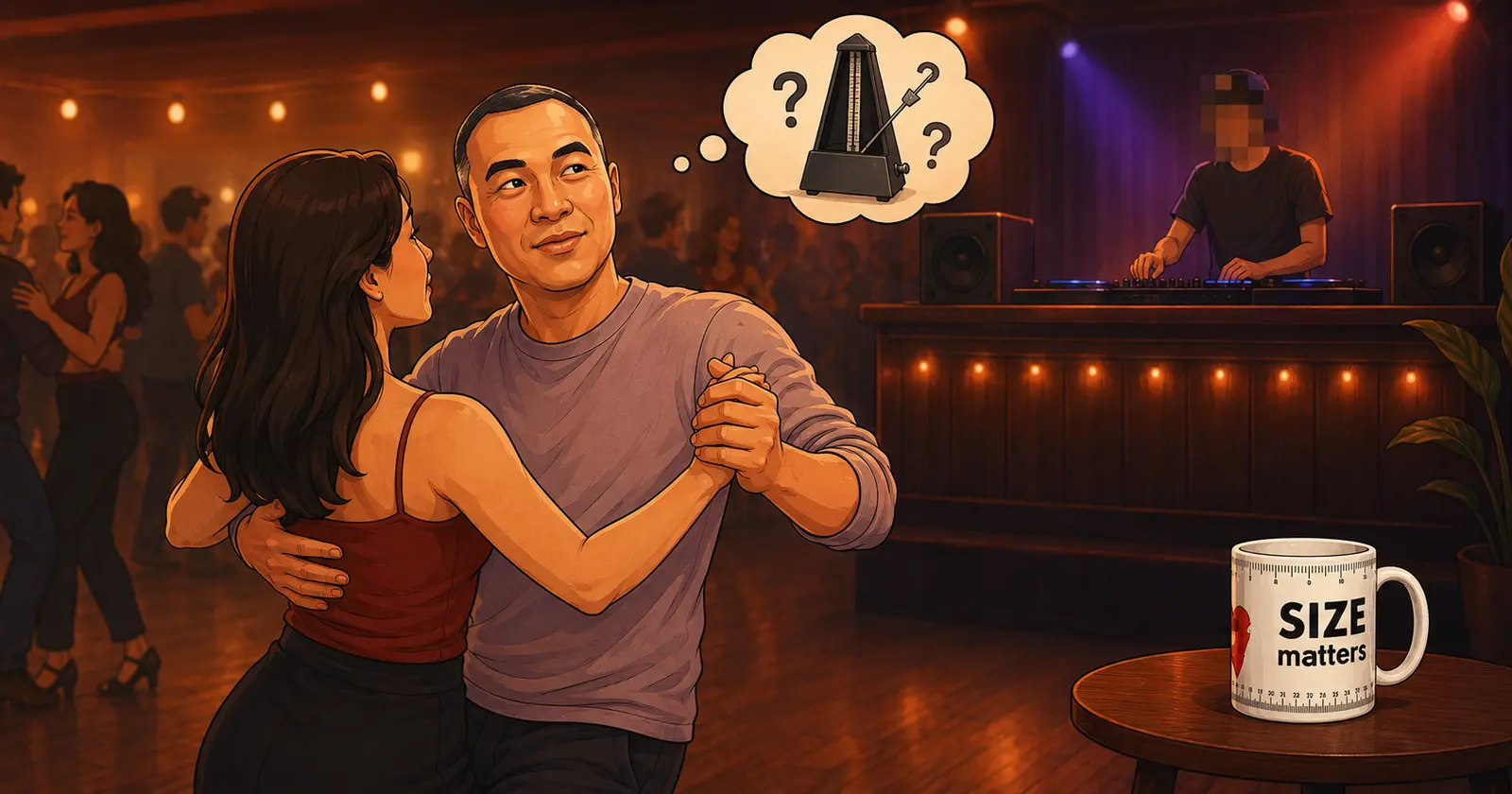
I’m not a DJ. I’m not a musician. But I am a dancer.
On average I listen to music around 10 hours a day, and I’ve been dancing for the last 15 years across a lot of different styles, both solo and partner. So when I talk about BPM (beats per minute, which is basically the speed of a song), I’m not talking about it from behind the decks. I’m talking about it from the floor.
When it comes to Brazilian Zouk, and probably a lot of other ballroom partner dances too, the BPM matters. That’s why DJs talk about it. That’s why they control it and adjust it.
The rough numbers
60 to 70 BPM: very slow and lyrical. Deep controlled isolations, head movement, suspension.
70 to 85 BPM: the sweet spot. Traditional Zouk and the RnB remixes.
85 to 95 BPM: fast, and still perfectly danceable if you know what you’re doing.
95 BPM and up: this is where you’re really into Lambazouk territory.
The one sentence version
The right BPM lets a dancer express their movements across a wider range of speeds.
Simple.
But why, how, what, and when? The why and the how are below. The what can be any part of your body shape and movement. And the when, that’s musicality, understanding how your movement can speed up when the music slows down, and slow down when the music speeds up. Mind fuck right?
I’m not here to teach you musicality in this blog, but that’s the gist of it. I could spend a whole blog or a whole evening talking about it, and I don’t want to lose focus on the topic at hand.
You need room in both directions
You need a BPM where dancers can move at twice the speed, or half the speed, and have it be physically possible while maintaining full control with no compromise to safety. Not mentally possible in your head when you’re being delusional. Physically possible.
Crazy fast is where the default speed is already impossible to stay on time consistently.
Now, nothing here is black or white. So here is the test I use. If a very experienced dancer can’t stay on time consistently at the default, it’s too fast. That’s it. That’s the whole test.
And asking a dancer to just dance at half speed by default is not the answer. The BPM needs to come down to something reasonable.
What the right BPM actually gives you
It creates opportunities. It gives a dancer room to extend the elasticity in their movements, to express, without having to rush to stay on time.
Play crazy fast music where the default is barely physically possible, and dancers have already lost the ability to speed up, because there’s nothing left above them. The only direction left is down.
But down to what, exactly? A quarter of the speed might be physically possible, but does it actually make any sense to? Half speed is possible too… and how long do you plan on dancing at half speed when the music underneath you is still too fast?
You’ve taken away half the range and left the dancer to survive on what’s left.
The music also has to support different rhythmic steps
Speed is one half of it. The other half is whether the music actually supports different rhythmic steps.
When it does, the song becomes more creative, because it opens up more opportunities to express. When it doesn’t, you get the same step, over and over, for five minutes.
This is one of the reasons RnB is so good for Brazilian Zouk, and it should be played more often.
So DJs, please do away with the flat monotonous mixes. Flat destroys creativity.
This is why a DJ needs to understand the dance
Sometimes a DJ is a brilliant musician. Sometimes a DJ is a brilliant DJ. And still not a great dancer, so they don’t understand what a dancer actually needs in order to dance comfortably.
That’s not an insult. They’re two different crafts.
Monotonous music
I haven’t even started on the importance of playing interesting music, the kind that takes you somewhere, compared to a mishmash of sound with no meaning.
Monotonous music is boring as fuck.
If you don’t know what monotonous means, it basically means boring, dull and repetitive, because it never changes or lacks variety. It’s another music choice I find very uninspiring.
It’s possible I just lack the discipline to hear anything else in it, or feel anything else in it. Who knows. But I genuinely don’t understand why anyone would want to play, or even create, 5 to 7 minutes of a song that is on repeat throughout the whole song and then expect someone to dance to it (Maybe it was originally created to help people fall asleep). Now imagine if a DJ’s whole set of selections were all monotonous, FML. I’ve experienced it. It happens and I always ask, WHY WOULD YOU DO THAT?!?! Kill me right now and end my suffering.
So, DJs
Two asks, and that’s me done.
Please learn how the dance works before you set your BPM or build your mixes.
And please don’t play too many monotonous tracks in a row.
Music selection is key to drawing new audiences in, and to keeping the audience you already have engaged, instead of leaving them to die of exhaustion or die of boredom.
You may also want to read my last blog, Bad music destroys the dance community more than you think, if you haven’t already. It has 3 simple rules worth considering when you’re preparing your sets for Brazilian Zouk dancers.