The Dunning-Kruger Syndrome in AI Is in Full Effect
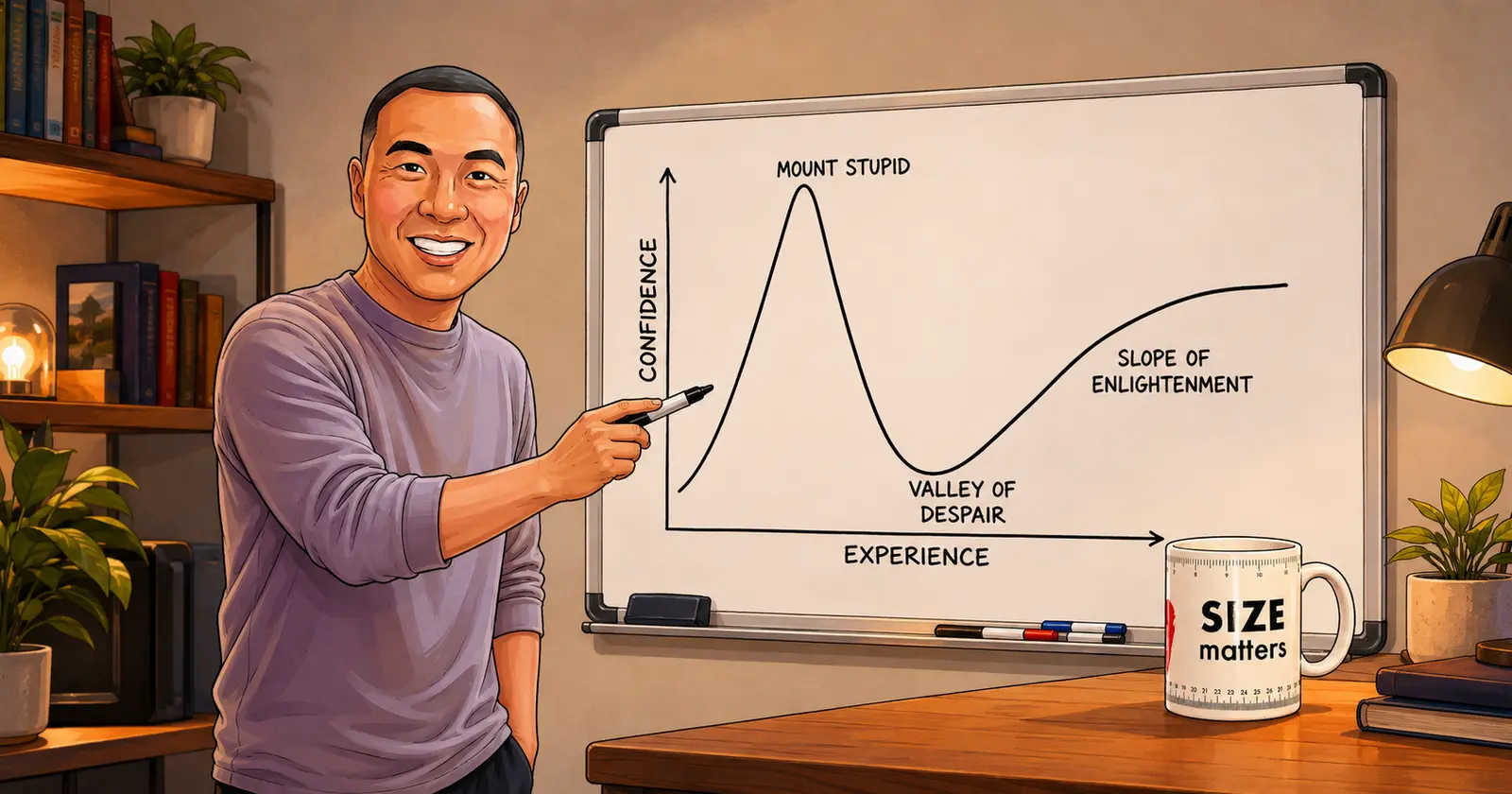
Years ago I wrote about the London Zouk scene and the dancers who had been around for ages, rarely turned up to class, and somehow still knew everything. Ego and over confidence. They think they are good, and they think that you think they are good. If a move goes wrong, it’s your fault, never theirs.
Same species. Different industry.
Because I’m seeing it everywhere in AI right now. Close minded, confident to a flaw, and dangerous to themselves and others.
So what is it, actually?
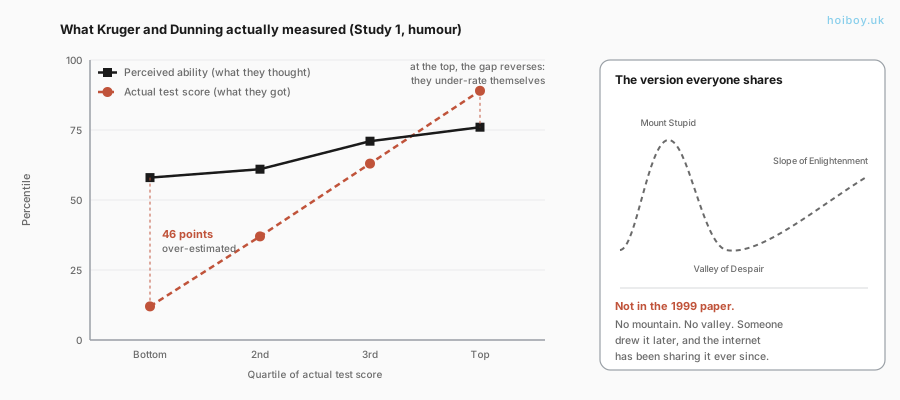
Kruger and Dunning, 1999. They tested people on humour, grammar and logic. The ones who scored in the bottom quarter put themselves in the 62nd percentile. They were actually in the 12th.
The paper opens with a bloke who robbed two banks in 1995 with lemon juice on his face, because he thought it made him invisible to cameras. He wasn’t drunk. He wasn’t mad. He’d tested it.
That’s the whole thing. The skills you need to do something well are the same skills you need to judge whether you’ve done it well. Miss the first, you miss the second automatically.
The chart everyone shares
Here’s the one you know. Mount Stupid, the Valley of Despair, the slow climb back up. It’s on every social media carousel on earth.
Two things before I use it. It isn’t from the 1999 paper, it’s somebody else’s interpretation that turned into a meme. And the study behind it has been disputed plenty of times since, so I won’t be handing you the numbers as gospel. The real chart sits next to it below, and it’s a lot duller.
I’m using the meme version anyway. Because it’s funny, and because it is exactly what I am watching happen right now.
The influencers are the superspreaders
It’s the influencers who seem the most infected. I’m seeing it everywhere. And they have the power to spread it like a virus, infecting the naive and the ignorant lot who don’t yet know enough to tell the difference.
That part I almost expect. It’s the next part that gets me.
Even people I would respect as professionals are getting bitten and turned into zombies. Genuinely sharp people. And they still go under.
I do not know why. Why does this happen? Some people are so smart, and yet they seem to lack something in certain areas that leaves them wide open to it.
Just remember, influencers are not your friends, they are not engineers, they are influencers, their goal is clickbaiting and your attention which is what they are being paid for. They are not out to solve your problems, they are out to solve theirs.
Why the clever ones get caught too
I finally remembered where I read about this. A book called Thinking in Bets by Annie Duke. I’m not saying she’s got it right, that’s just where I came across it.
The idea is that smarter people are better at motivated reasoning, because they can come up with more ways to explain away anything that doesn’t suit them. There’s a study she quotes where people were given a maths problem. Dressed up as a skin cream trial, the ones best at maths did best at it. Dressed up as a study about gun control, the answers split along political lines and got less accurate, and the split was widest among the people best at maths. They used their ability to grind out whichever answer matched what they already believed.
Being clever doesn’t protect you. It just means you’re better equipped to build a case for whatever you’d already decided. The ego does the deciding, the intelligence does the paperwork.
Be fearless at being wrong
One thing I learned from dancing, from entrepreneurship, and from trading. All three taught me the same lesson and changed me differently for it.
Be fearless at being wrong.
That doesn’t mean giving up when you’re wrong. It means you’re going to be wrong most of the time, so keep learning from the mistakes, keep making small changes, keep analysing and studying where you can improve, and be okay with it. If you’re not making mistakes, you’re not learning. It’s that simple and it’s that hard. When exploring new territories, it’s hard to know when right or wrong, so experiment, trial and error.
The problem with denying you’re wrong is what you do next. You go and seek justification for why you’re right. You’re now spending your energy defending a position instead of learning why it failed and improving from it. And the moment you’re doing that, you stop growing.
It’s the same failure the whole post is about, just from the inside.
The funny thing is the 1999 paper actually landed on this too. Their last finding was that you can give people the ability to see their own gaps, and the only way to do it is to make them better at the thing. Competence and humility arrive together, or neither shows up. You can’t shortcut to the humility.
I’d rather respect someone for how they improve over time and how they learn than for a piece of certificate that says they passed. Someone who can put their hands up and admit they made a mistake and were wrong. That, to me, is worth more than any qualification.
What school never taught
One thing I don’t see taught anywhere is philosophy, and how to be humble. Then again, how to build wealth, doing taxes and investing aren’t taught at school either, so maybe I’m asking too much.
I think the education system is backwards, because there’s nothing wrong with being wrong. Yet being wrong gets penalised and recorded as a failure, instead of being used as a gauge or a timeline of improvement. Imagine if your school report showed the distance you’d travelled instead of where you landed on one particular Tuesday.
Then again, the way I see it, the education system was built for the rat race in the first place. To create workers.
Thankfully there’s a lot of learning outside of it. Pick up books, read from reputable and inspiring people who have actually lived. If you want to expand your knowledge, don’t read the conventional stuff, go and find the books that expand your mind. I’ve got a decent list going, every book I’ve read in 20 years, so have a look through that if you want a starting point.
And if it turns out I’m wrong about some of this, good. That’s the point. Tell me and I’ll go and check it, the same way I checked the graph.